Taggart Wilde
The Big SleepTaggart Wilde is the Los Angeles District Attorney whose handling of the Geiger and Brody murders shows how public authority can seek a workable account of events rather than a full public reckoning. He challenges Philip Marlowe’s conclusions, acknowledges the costs of Marlowe’s concealment, and considers separating the killings in the official record so that General Guy Sternwood’s name is kept out of both.
Identity and Introduction
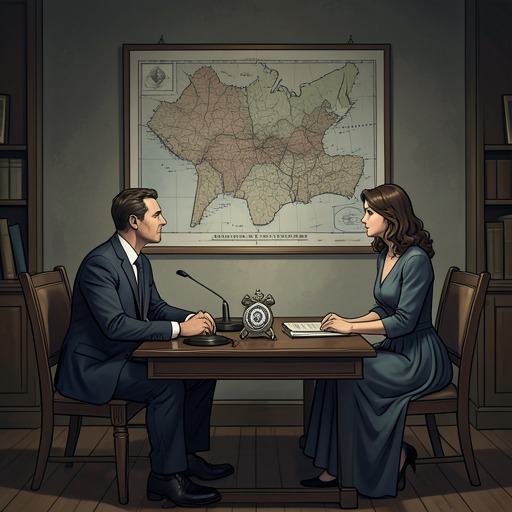
Wilde is introduced at his large, old-fashioned house near Fourth Street and Lafayette Park. The residence, with its lawn and sandstone entrance, establishes him as a figure embedded in Los Angeles’s established civic order. Marlowe arrives with Bernie Ohls and Captain Cronjager, bringing into Wilde’s private study a dispute over the deaths connected to Arthur Gwynn Geiger and Joe Brody.
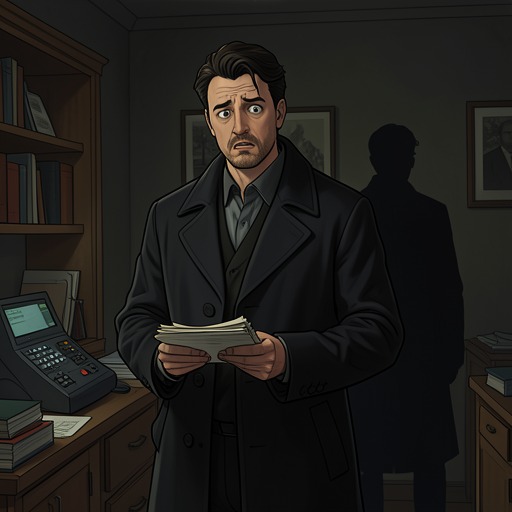
Wilde’s appearance reinforces his practiced authority. He is middle-aged and plump, with clear blue eyes whose friendliness is difficult to read; he drinks black coffee and handles a thin cigar with careful fingers. His manner is measured, not theatrical. He receives Marlowe while Captain Cronjager is present and says that he will try to handle the captain, recognizing that the case has become a difficult matter for a large city.
Dispute Over the Investigation
Wilde does not accept Marlowe’s reasoning without challenge. When Marlowe argues that Owen Taylor killed Geiger and that Brody was not the killer, Wilde points out that even a gun found on Taylor would not, by itself, prove who fired it: Brody might have planted it. His objection marks a distinction between a plausible reconstruction and a conclusion that can be securely established from physical evidence.
The exchange also makes the consequences of Marlowe’s choices explicit. Captain Cronjager accuses him of failing to report Geiger’s murder and then spending the day in a way that allowed Geiger’s associate to kill Brody. Marlowe admits that he had acted to protect his client and had not expected the second killing. Wilde lets the argument continue until Marlowe answers Cronjager’s charge, then cuts off the dispute and returns the discussion to the evidentiary problem.
Official Account and Cover-Up
After Cronjager leaves, Wilde tells Marlowe that he understands why a police officer would resent a cover-up. He nevertheless says that Marlowe will need to make statements for the files and that it may be possible to keep the two killings separate while keeping General Sternwood’s name out of both. The qualification matters: Wilde does not promise that the facts can simply disappear, but he is prepared to consider how they will be recorded and presented.
The next morning’s newspapers show the kind of public narrative that emerges. Their accounts credit Cronjager with solving two supposedly connected killings arising from a dispute over Geiger’s wire-service business; they say that Brody killed Geiger and Carol Lundgren killed Brody in revenge. They omit the Sternwoods, Marlowe, and Ohls, and treat Taylor as a despondent chauffeur whose car went into the water. The official and newspaper version therefore differs sharply from Marlowe’s reconstruction, which identifies Taylor as Geiger’s killer and rejects Brody as the murderer.
Narrative Significance
Wilde’s role is not that of a simple obstacle or an unquestioning ally. He recognizes the institutional cost of concealing a murder and presses Marlowe on the weakness of treating circumstantial reasoning as proof; at the same time, he entertains a limited concealment designed to protect the Sternwood family from public association with the deaths. His conduct places legal responsibility, evidentiary uncertainty, and political discretion in the same room.
That tension helps define the novel’s treatment of official narratives. The newspaper account supplies a clean solution and assigns credit, but leaves out the connections that would implicate the powerful family. Wilde’s willingness to consider keeping the cases separate makes him part of the machinery by which a complicated chain of events can become a manageable public story, even when Marlowe’s private account remains more persuasive to him.